Cloud Hosting in India: The Complete Guide for Growing Businesses
If your website slows to a crawl during a flash sale, or your application crashes the moment traffic spikes, the problem usually isn't your code — it's your hosting. For years, Indian businesses relied on traditional servers that offered fixed resources, fixed costs, and very little room to grow. Today, that model is being replaced by something far more flexible: cloud hosting.
Whether you're a startup founder trying to keep infrastructure costs predictable, an IT manager responsible for uptime SLAs, or a DevOps engineer tired of manual scaling, understanding cloud hosting is no longer optional — it's foundational to how modern businesses operate online.
In this guide, we'll break down what cloud hosting actually is, how it differs from other hosting types, why it matters for Indian businesses specifically, and what to look for when choosing a provider.
What Is Cloud Hosting?
Cloud hosting is a way of hosting websites, applications, and data across a network of interconnected virtual servers, rather than relying on a single physical machine. Instead of your website living on one server that can fail or run out of resources, it draws power from a distributed pool of computing resources — storage, RAM, and processing power — that can expand or contract based on real-time demand.
Think of traditional hosting like renting a single room: you get exactly what's allotted, and if you need more space, you have to move. Cloud hosting is more like living in a building where you can knock down or add walls on demand. Need more power during a big product launch? It's there in minutes, not weeks.
This elasticity is why platforms like our Cloud Hosting solutions have become the default choice for businesses that can't predict — or don't want to be limited by — their traffic patterns.
Cloud Hosting vs. Dedicated Servers vs. VPS Hosting
It's easy to get these three terms confused, so here's a quick breakdown:
Shared/Web Hosting: Multiple websites share a single server's resources. Cheap, but limited in performance and scalability. Best for small blogs or brochure sites — see our Web Hosting plans.
VPS Hosting: A physical server is divided into isolated virtual compartments, each with guaranteed resources. It's a solid middle ground between shared hosting and full dedication — explore VPS Hosting options.
Dedicated Servers: An entire physical machine is yours alone, offering maximum control and raw performance for heavy workloads. Ideal for large enterprises — see our Dedicated Server range.
Cloud Hosting: Resources are pulled from a distributed network of virtual servers, meaning there's no single point of failure and capacity scales instantly with demand.
None of these is universally "better" — the right choice depends on your workload, budget, and growth trajectory. Many growing businesses actually start on VPS hosting and migrate to cloud hosting once traffic becomes unpredictable or mission-critical.
Why Cloud Hosting Matters for Indian Businesses in 2026
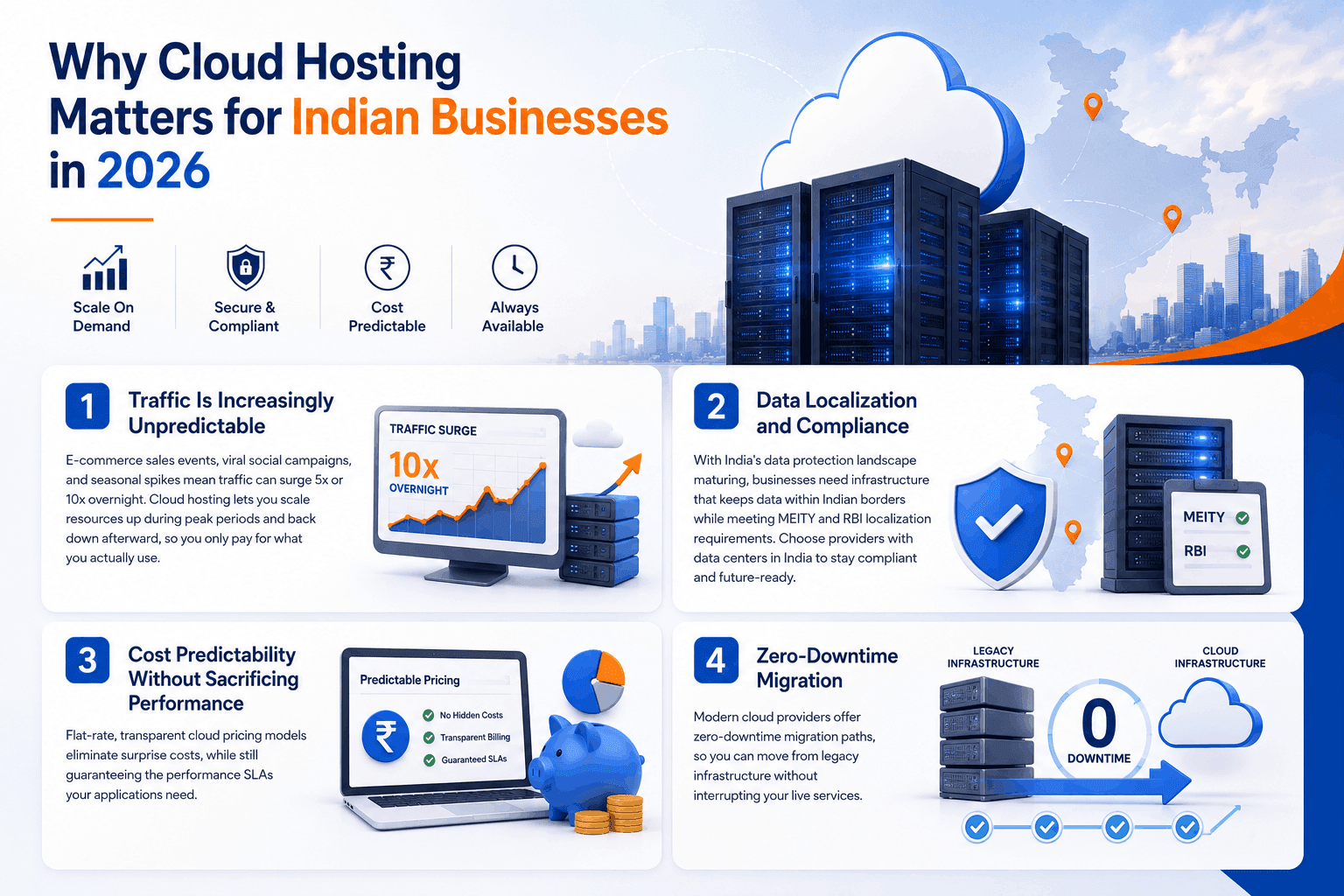
1. Traffic Is Increasingly Unpredictable
E-commerce sales events, viral social campaigns, and seasonal spikes mean traffic can surge 5x or 10x overnight. Traditional infrastructure either buckles under the load or sits idle (and expensive) the rest of the year. Cloud hosting lets you scale resources up during peak periods and back down afterward, so you only pay for what you actually use.
2. Data Localization and Compliance
With India's data protection landscape maturing, businesses handling customer data — especially in fintech, healthcare, and e-commerce — need infrastructure that keeps data within Indian borders while meeting MEITY and RBI localization requirements. Choosing a provider with data centers physically located in India, such as ICSDC's facilities in Noida and Mumbai, removes a major compliance headache.
3. Cost Predictability Without Sacrificing Performance
CFOs and founders want to avoid unpredictable infrastructure bills. Flat-rate, transparent cloud pricing models eliminate the surprise costs that come with traditional over-provisioning, while still guaranteeing the performance SLAs your applications need.
4. Zero-Downtime Migration
One of the biggest barriers to adopting cloud hosting has historically been fear of the migration process itself. Modern cloud providers now offer zero-downtime migration paths, meaning you can move from legacy infrastructure without interrupting your live services.
Key Features to Look for in a Cloud Hosting Provider
Not all cloud hosting is created equal. Before you commit, evaluate providers against these criteria:
Guaranteed Uptime SLA Look for a verifiable uptime guarantee — ideally 99.95% or higher — backed by a formal Service Level Agreement, not just marketing language.
Elastic, On-Demand Scaling Your provider should let you scale compute, storage, and bandwidth instantly, without downtime or manual reconfiguration.
Local Data Centers For Indian businesses, having infrastructure physically located in India (not just a CDN edge node) reduces latency and simplifies regulatory compliance.
Managed Support Options If your team doesn't have deep DevOps bandwidth, a Managed Cloud Hosting plan can offload patching, monitoring, and optimization to the provider's engineers.
Security and Backup Look for enterprise-grade firewalls, DDoS protection, and integrated backup solutions like Acronis Backup or Veeam Backup to ensure business continuity even in worst-case scenarios.
GPU and Specialized Workload Support If you're running AI/ML workloads, video rendering, or data-intensive applications, check whether the provider offers GPU Cloud Hosting with the compute power those workloads demand.
Transparent, Flat-Rate Pricing Avoid providers with confusing tiered billing. A transparent flat-rate model makes budgeting significantly easier for finance teams.
Common Cloud Hosting Use Cases
- E-commerce platforms handling seasonal traffic spikes during sales events
- SaaS applications that need to scale horizontally as user bases grow
- Fintech and banking applications requiring RBI-compliant, India-based data residency
- AI/ML workloads that need burstable GPU access without large upfront hardware investment
- Enterprise applications migrating away from legacy on-premise infrastructure
- Agencies and DevOps teams managing multiple client environments that need to spin up and down quickly
Windows or Linux? Choosing Your Cloud OS
Your operating system choice affects compatibility, licensing costs, and available tooling.
Linux Cloud Hosting is typically preferred for open-source stacks, containerized applications, and cost efficiency — it dominates in DevOps-heavy environments.
Windows Cloud Hosting is the better fit if your applications depend on the .NET framework, MS SQL Server, or other Microsoft-specific tooling.
Most providers, including ICSDC, support both, so this decision should be based on your application stack rather than provider limitations.
Cloud Hosting and Business Continuity
Downtime isn't just an inconvenience — it's a direct hit to revenue, customer trust, and in regulated industries, potential compliance violations. Cloud hosting architectures are inherently more resilient than single-server setups because workloads can be automatically shifted away from failing components without users ever noticing.
Pair that resilience with proper Firewall Security, SSL encryption via SSL Certificates, and a solid disaster recovery plan through Cloud Storage, and you have an infrastructure stack built to withstand both technical failures and security threats.
Making the Switch: What Migration Actually Looks Like
Many businesses delay moving to cloud hosting simply because migration sounds risky. In practice, a well-planned migration follows a predictable path:
Assessment — Auditing your current infrastructure, dependencies, and traffic patterns.
Architecture Planning — Designing the target cloud environment, including scaling rules and redundancy.
Staging and Testing — Replicating your environment in the cloud and testing thoroughly before cutover.
Zero-Downtime Cutover — Switching traffic over using DNS and load-balancing techniques that avoid service interruption.
Post-Migration Optimization — Fine-tuning performance, monitoring, and cost efficiency once live.
A provider with real migration experience and 24/7 support will guide you through each of these steps rather than leaving you to manage the transition alone.
Final Thoughts
Cloud hosting has moved from being a "nice to have" to a core requirement for any business that wants to scale reliably, control costs, and stay compliant with India's evolving data regulations. The right provider doesn't just rent you server space — they become an extension of your infrastructure team, offering guaranteed uptime, transparent pricing, and local expertise that global-only providers often can't match.
If you're evaluating cloud hosting for your business, it's worth comparing providers not just on price, but on uptime guarantees, data center location, migration support, and the depth of managed services on offer.
Ready to explore what cloud hosting can do for your business? Talk to our team or check out our Cloud Hosting plans to find the right fit for your workload.